Author: Marc Ferguson

  • The Great Parts Squeeze

    The Great Parts Squeeze

    Your Airplane Is Fine. Mostly.

    There are few phrases in aircraft ownership more dangerous than:

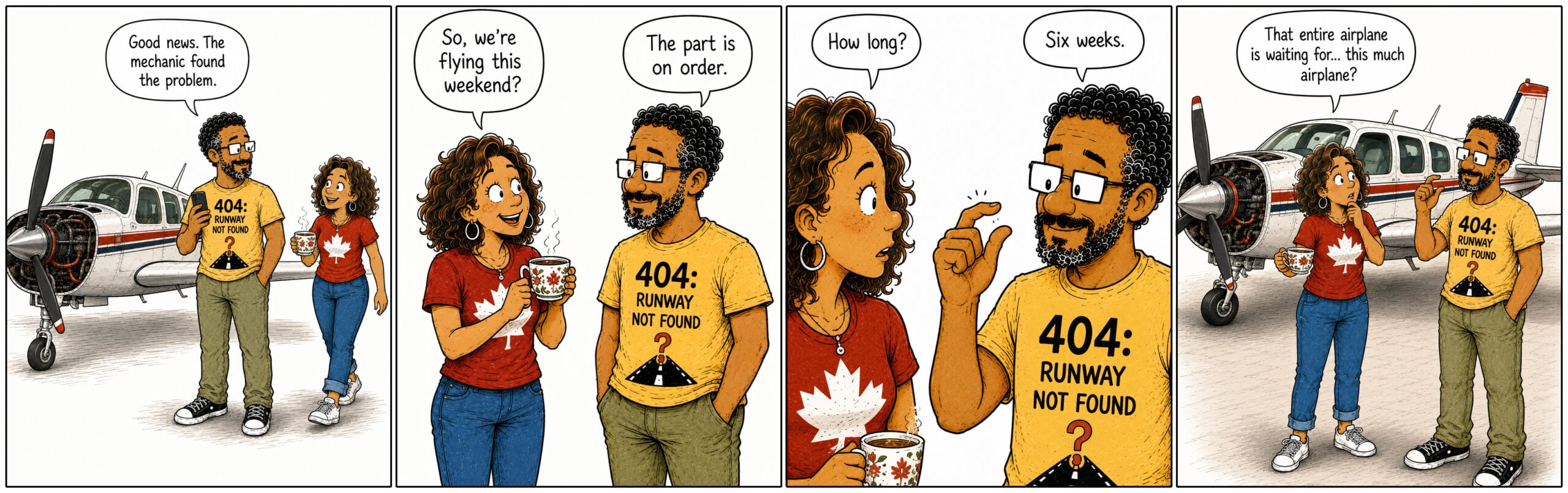
    “Good news. We found the problem.”

    For about three seconds, you feel relief. The troubleshooting is over. The mystery has been solved. Surely we’re almost back in the air.

    Then comes the second sentence.

    “The part is on order.”

    Ah.

    So begins one of general aviation’s least exciting waiting games.

    2,000 Pounds of Airplane, One Tiny Problem

    That’s the absurdity behind this week’s comic.

    You can have an otherwise perfectly capable airplane sitting in a hangar because one comparatively tiny component isn’t available. The airplane doesn’t care that the weather is perfect this weekend. Your calendar doesn’t matter. Neither does the flight you’ve been planning.

    The airplane needs its part.

    And until it gets one, congratulations on your new hangar decoration.

    For non-airplane people, this can be difficult to comprehend. That’s why Kat’s question gets right to the heart of it:

    “That entire airplane is waiting for… this much airplane?”

    Yes.

    Yes, it is.

    Finding the Problem Is Only Half the Battle

    Aircraft maintenance has always involved downtime, but getting a diagnosis doesn’t necessarily mean getting a quick resolution.

    The mechanic can know exactly what’s wrong. The repair itself might not even be particularly dramatic. But the airplane still needs the correct approved component, and that component has to actually exist somewhere you can get it.

    That’s when an aircraft owner discovers that “on order” isn’t really a status.

    It’s a lifestyle.

    The Most Expensive Thing in the Hangar Is Patience

    Pilots spend a lot of time talking about performance: horsepower, useful load, range, fuel burn and cruise speed.

    Nobody puts parts availability on the performance chart.

    Maybe we should.

    Because your Bonanza can cruise all day at 160-plus knots, but when the right part is six weeks away, its effective cruise speed becomes approximately zero knots.

    At least the fuel burn is excellent.

    Welcome to Aircraft Ownership

    There’s a reason aircraft owners develop a particular sense of humor.

    Sometimes you fly.

    Sometimes you maintain.

    And sometimes you visit your perfectly good airplane in the hangar and assure it that its tiny little package will be here soon.

    Probably.

  • How to Practice Density Altitude in a Flight Simulator—Before the Runway Gets Expensive

    How to Practice Density Altitude in a Flight Simulator—Before the Runway Gets Expensive

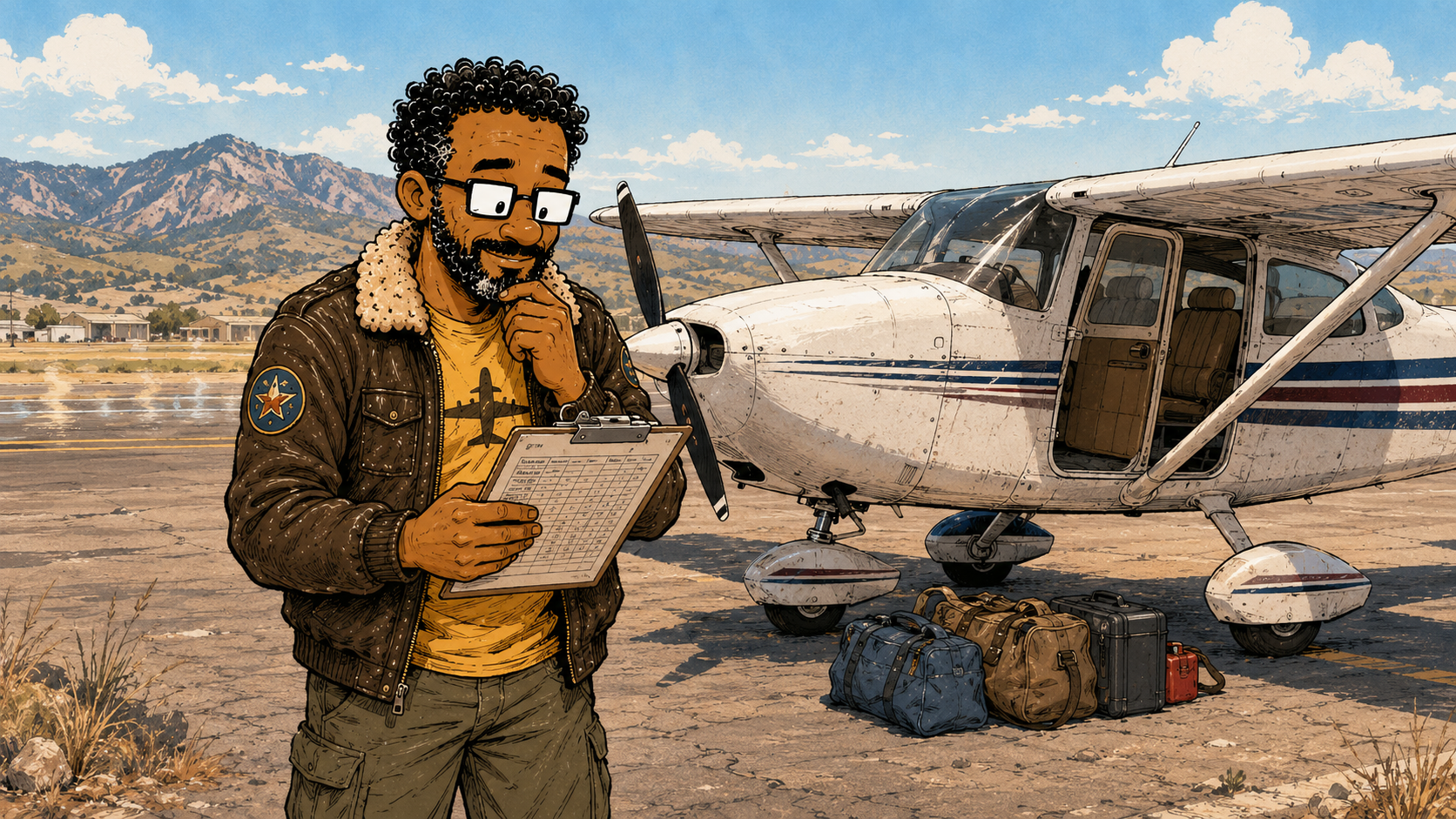
    You load a Cessna 172 at Centennial Airport (KAPA) near Denver. Four people, bags, nearly full fuel, and a summer afternoon hot enough to make the ramp shimmer.

    In the simulator, you can push the throttle forward and see what happens. In the real world, “let’s find out” is not much of a departure briefing.

    Learning how to practice density altitude in a flight simulator turns that ordinary takeoff into something more valuable: a rehearsal for making the decision before the airplane makes it for you.

    Your Altimeter Is Technically Innocent

    Density altitude is not simply the airport’s elevation. It describes how the aircraft experiences the air after pressure and temperature are considered. Hotter, thinner air makes the airplane perform as though it were operating from a higher elevation.

    The FAA warns that high density altitude reduces engine power, propeller efficiency, and climb performance while increasing the runway required for takeoff.

    So, the runway has not become shorter—but your safety margin may have quietly packed a bag and left.

    Same Airplane, Different Attitude Problem

    Here is a useful simulator exercise.

    Choose a normally aspirated GA aircraft at a high-elevation airport. Load it with realistic passengers, baggage, and fuel. Fly the departure once during a cool morning, then repeat it during a hot afternoon without changing anything else.

    Watch the ground roll. Note where the airplane lifts off, how quickly it climbs, and whether you can comfortably clear nearby terrain. Then remove some weight, reduce fuel within safe planning limits, or move the departure to an earlier hour.

    Now you are not merely practicing takeoffs. You are comparing choices.

    Your desktop simulator may not reproduce every performance number with POH-level accuracy, so it should not replace the aircraft’s Pilot’s Operating Handbook or instruction from a CFI. It can, however, help you recognize the problem and build the habit of asking better questions.

    Odyssey Is in the Consequences

    This is the kind of GA decision Odyssey Command is being designed to make meaningful. A mission should not be available simply because you clicked it. Weather, aircraft capability, loading, currency, and pilot judgment should matter.

    Perhaps the correct answer is carrying less cargo. Perhaps it is departing at sunrise. Sometimes the correct answer is staying parked—and that still counts as good aviation.

    Try the exercise yourself this week. Pick a mountain airport, change only the temperature, and see when the same flight stops feeling routine.

    Flight simulation becomes an on-ramp to real aviation when we stop asking, “Can the simulator let me do this?” and begin asking, “Would a pilot make this choice?”

    Sources

  • Worth Every Year: Taylor Flat Is Back

    Worth Every Year: Taylor Flat Is Back

    So, a backcountry airstrip in northeastern Utah just reopened after thirty years of sitting dormant — and the story of how it got there is one of the most aviation things I’ve ever read.

    Taylor Flat Airstrip, identifier TF6, sits near the Green River in Daggett County. It’s remote in the way Utah backcountry tends to be remote — red canyon walls, scrubby desert brush, enormous sky. And for roughly three decades, it just… sat there. Unused. Off the charts for most practical purposes.

    Now it’s back.

    Thirty Years on the Ground

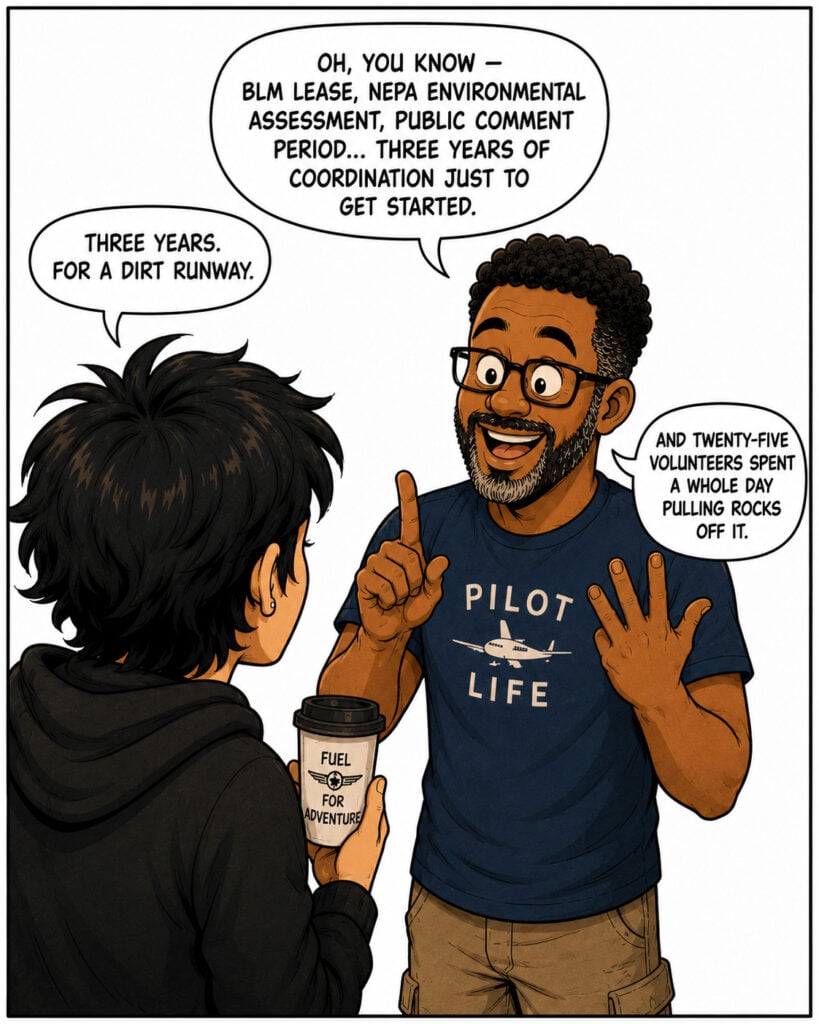
    The effort to reopen TF6 started in 2023, when the Recreational Aviation Foundation and Utah Back Country Pilots began coordinating with the Bureau of Land Management and Daggett County. What followed was a full NEPA environmental assessment, a right-of-way lease application, a public comment period — the whole process. Three years of navigation through the kind of bureaucratic terrain that would make most people quietly give up and go fly somewhere else.

    They didn’t.

    On May 9th, 25 volunteers showed up at Taylor Flat and got to work. Rocks off the runway. Ditches filled. New windsock pole installed. Runway corners, thresholds, and restricted areas marked. The next morning, RAF Ambassador John Clayton landed — the first aircraft to touch down at Taylor Flat in thirty years.

    I read that and felt something. That’s the only way I can describe it. There’s a version of aviation that lives entirely in the machine — the systems, the procedures, the numbers. And then there’s this version; the one where people drive out to a patch of Utah desert on a Saturday and pull rocks out of the ground because they believe a dirt strip is worth saving.

    Cleared for the Approach (Eventually)

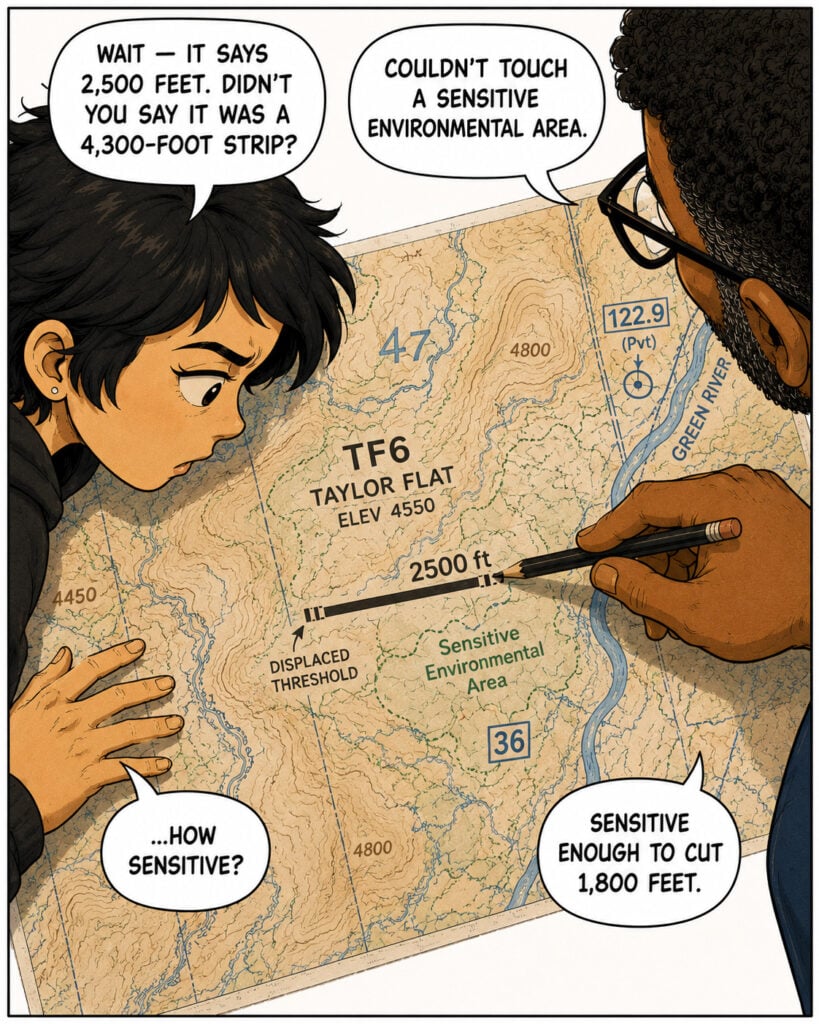
    Now — the original strip was 4,300 feet. During the restoration, the runway was shortened to 2,500 feet. A displaced threshold was added on the east end to avoid disturbing a sensitive environmental area near the river.

    Haebin and I didn’t make it out there ourselves — but we made a comic about it, because some stories just ask for that treatment.

    About That Sensitive Area…

    In all seriousness — from everything I’ve seen of Utah backcountry, the landscape out there is genuinely beautiful. The kind of place that makes the paperwork feel, in retrospect, like a reasonable price of admission.

    But the sensitive area does sound remarkably like all of it. Utah has a way of making every patch of scrub feel equally significant and equally indistinguishable from the next one. So does bureaucracy, in its own way. Haebin had thoughts. Marc — fictional Marc, standing in that imaginary desert — was unbothered.

    The Real Payload

    What strikes me most about this story isn’t the runway length or the environmental review. It’s the three years.

    That’s a long time to stay committed to a piece of ground that isn’t serving anyone yet. RAF Liaison Wendy Lessig drove that process — following through on the public review from beginning to end, keeping it moving when it would have been easy to set it aside and call it done.

    That persistence is the story. The reopening is just what happens when the persistence doesn’t stop.

    If you want to read the full account, AVweb covered it well: Taylor Flat Airstrip Reopens In Utah

    And if you’ve got TF6 — or any Utah backcountry strip — in your logbook or on your list, I’d love to hear about it. Drop it in the comments or come find us in the Discord.

    Worth every year.

  • Odyssey Aviation Scales Back to Focus on Tier 1

    Odyssey Aviation Scales Back to Focus on Tier 1

    When Odyssey Aviation first launched, we set out to create a membership platform that offered something for everyone—from casual simmers looking for fresh routes to hardcore aviators chasing contests and career progression. Our tier system reflected that vision:

    • Tier 1: Adventure Pack – flight plans, handcrafted scenery, charts, and navigation tools.
    • Tier 2: Aviators’ Club – group flights, early access, and community input.
    • Tier 3: Sky League – contests, economy integration, and leadership opportunities.

    Over the past months, one thing has become clear: Tier 1 is the foundation. It’s where every pilot starts their journey, and it’s where we’ve seen the most excitement, feedback, and engagement.

    That’s why we’ve made the decision to scale back and focus entirely on the Adventure Pack (Tier 1) for now. By putting our full energy into the Adventure Pack, we can polish the experience, strengthen the content pipeline, and make sure that every pack is delivered as a “well-oiled machine.”

    This doesn’t mean Tiers 2 and 3 are gone forever. Quite the opposite:

    • Tier 2 (Aviators’ Club) will return once we’re confident Tier 1 is rock solid. When it comes back, it’ll be stronger, more consistent, and better aligned with what the community actually wants.
    • Tier 3 (Sky League / Odyssey Command) will eventually live on its own dedicated platform—a place where career progression, contests, and immersive economy gameplay can thrive without being held back.

    For now, the message is simple: Adventure Pack is our priority. Each month you’ll continue to get handcrafted routes, detailed briefings, charts when available, and immersive scenery built for exploration.

    We appreciate the support of every member of our community who’s flown with us so far. Scaling back isn’t a step backward—it’s making sure that when we scale up again, it’s sustainable, consistent, and true to the Odyssey spirit.

    Blue skies ahead,
    Marc Ferguson
    Founder, Odyssey Aviation

  • Flight Sim Training: Pros, Cons, and the Communities Changing the Game

    Flight Sim Training: Pros, Cons, and the Communities Changing the Game

    Is Flight Sim Training Worth It? Let’s Break It Down.

    Flight simulation has come a long way from its pixelated roots. Today, it’s more than just a hobby—it’s a launchpad into real-world aviation, a place to connect with fellow pilots, and for many, the first step in building lasting skills. But is it actually a solid form of training? Let’s break down the pros and cons—and look at how communities like TPC, VATSIM, and platforms like Odyssey Aviation are reshaping the skies for simmers everywhere.

    ✈️ Pros of Flight Sim Training

    1. Practice Without the Price Tag

    Flight hours are expensive. With a sim setup, you can log dozens of “virtual hours” practicing pattern work, emergency procedures, or mountain approaches—without draining your wallet. Whether you’re using default routes or exploring handcrafted journeys from communities like Odyssey Aviation, the accessibility is unmatched.

    2. Realistic Scenarios, Real Skills

    Modern sims pair with tools like Navigraph, Little Navmap, and Odyssey’s Google Earth overlays to help pilots develop real-world habits. You’ll learn to brief your route, check NOTAMs, monitor terrain, and adjust to crosswinds—all from your desktop.

    3. ATC Immersion with VATSIM

    Live ATC makes all the difference. With VATSIM, you’re flying in a real-time airspace full of other pilots and human controllers. That pressure to communicate well? It’s real—and incredibly valuable. Many Odyssey members find that combining ATC practice with structured routes helps reinforce both navigation and radio skills.

    4. A Supportive Community

    Training isn’t just about logging hours. It’s about feedback, encouragement, and momentum. Organizations like The Pilot Club (TPC) offer this in spades with scheduled group flights, free flight school programs, and role-specific Discord channels. Odyssey Aviation echoes this model by building community events, monthly contests, and collaborative missions through its own network.

    ⚠️ The Cons (Yeah, It’s Not Perfect)

    1. Information Overload

    Between simulator settings, aircraft systems, charts, and ATC phraseology, simming can overwhelm beginners. That’s why structured programs—like TPC’s Flight School or Odyssey’s Adventure Packs with built-in briefings—are essential for onboarding.

    2. No “Seat-of-the-Pants” Feel

    Sims can’t replicate G-forces or peripheral depth. But that hasn’t stopped platforms like Odyssey from designing flights that mentally challenge pilots—whether it’s density altitude at Sumers Airpark or turbulence over the fjords of Norway.

    3. ATC Gaps

    VATSIM coverage can be spotty at times, especially outside of peak events. Still, pairing your sim sessions with a guided training path (TPC), or using VATSIM alongside Odyssey’s pre-planned flight briefings, can fill those gaps by keeping you focused on learning objectives even when skies are quiet.

    4. Not a Real Certificate

    Let’s be clear: you won’t walk away with an FAA certificate. But many simmers find that programs like Odyssey Command or TPC’s P-rating system give them a better foundation than the average first-time student pilot.

    🎓 Spotlight: TPC Flight School

    The TPC Flight School, built by The Pilot Club, is a VATSIM-Authorized Training Organization (ATO) that’s 100% free to members. It’s structured, guided, and powered by real-world CFIs and ATP-rated instructors who walk you through VATSIM procedures and pilot fundamentals.

    • Live instructor flights and checkrides
    • Presentation + video lessons
    • Quizzes and practical missions
    • Certification-style P1 through P4 training

    It’s the closest thing to a real-world syllabus—made by and for simmers. For those who want to go deeper, many also explore Odyssey Aviation’s unique Adventure Packs and virtual airline progression system, offering more variety once you’re comfortable in the cockpit.

    🌐 What VATSIM Does Best

    VATSIM adds life to the sim. It turns every flight into a shared experience—whether you’re on final into JFK during Cross the Pond or getting clearance for a sleepy GA hop. Even Odyssey’s themed events are often designed with VATSIM in mind, giving you the chance to interact with ATC while completing missions that go beyond the usual point-A-to-B grind.

    🧭 Why Odyssey Aviation Deserves Your Radar

    While VATSIM and TPC handle the procedural and educational side of simming, Odyssey Aviation steps in as the ultimate experience enhancer. Think of it as a monthly adventure club for sim pilots—complete with handcrafted scenery, narrative-driven flight plans, and career progression through Odyssey Command.

    • Fly scenic, lore-rich routes from rugged Colorado airstrips to misty fjords
    • Compete on monthly leaderboards based on distance, fuel use, or mission success
    • Use Odyssey’s Discord to connect with pilots flying the same missions
    • Learn real-world techniques by flying detailed routes with EFB tools and terrain briefings

    Odyssey isn’t about getting your PPL—it’s about building your love for aviation so you want to go get it.

    Final Approach

    Flight simulator training is as deep and rewarding as you make it. When paired with structured learning (TPC), immersive realism (VATSIM), and community-driven adventure (Odyssey Aviation), you get a trio that not only teaches you how to fly—but why we fall in love with flying in the first place.

    So whether you’re taxiing for your first VFR flight or logging hours toward Odyssey Command’s Chief Aviator rank, the virtual sky is yours to explore.

    🛫 Now boarding.

  • Operation: Tango Tango

    Operation: Tango Tango

    July is here—and with it comes heat, humidity, and high-stakes flying. As towering clouds form across the Southeast and Gulf States, Odyssey Command launches Operation: Tango Tango – Thunderstorm Territory, a new mission arc in our ongoing Pilops campaign.

    This month, we challenge pilots to fly through one of the most volatile weather corridors in the U.S., where convective storms dominate the airspace and every route could turn dangerous.

    🏆 Contest Details

    🎁 Grand Prize: A GTN 750 license from PMS50
    💰 Value: â‚Ź50

    Scoring Criteria

    The leaderboard is based on three key performance areas:

    MetricHow to Earn
    ✈️ Total Flight HoursComplete Pilops-dispatched flights for airline ODY during the contest period.
    🛫 Number of FlightsEach completed flight for ODY counts. Fly often, even short STOL missions matter.
    💬 Total Discord XPComplete tasks to earn XP via MEE6.

    All three metrics are weighted equally—so consistency matters. A pilot who flies often, logs good hours, and stays active in Discord will rise to the top.

    Earn points on Discord by completing the following tasks:

    TaskPoints
    Complete a Pilops mission and submit after-action report+15
    Post a picture or video of your flight in Discord+5
    Join the weekly Sky League Dispatch flight+10
    Takeoff or land at a designated challenge airport+8
    Fly with another ODY pilot (formation or escort)+7

    Track your progress in our Discord channel and compete on the leaderboard!

    Mission Focus

    From cargo drops in rural strips to emergency reroutes and WX station deliveries, every mission this month is shaped by the forecast. Whether you’re flying with live weather or storm presets, your objective remains the same: adapt, complete the job, and get home safe.

    Pilops flights completed in this region will earn standard P$—with bonus rewards for completing themed objectives and engaging in Sky League Dispatch events.

    Tango Tango Corridor

    This month’s ops area spans across:

    • Florida, Georgia, Alabama, Mississippi, Louisiana
    • Arkansas, Missouri, Tennessee, Oklahoma, Texas
    • Southern Kansas and the lower Midwest

    These hubs serve as primary launch points:

    ICAOAirport NameStateNotes
    KATLHartsfield–Jackson Atlanta IntlGAMain Southeast dispatch hub
    KTPFPeter O. Knight AirportFLLow-altitude Gulf coast ops
    KHSVHuntsville InternationalALWX ops and Alabama support
    KLITBill & Hillary Clinton NationalARCentral Arkansas mission center
    KTULTulsa InternationalOKMid-continent weather corridor
    KNEWNew Orleans LakefrontLACoastal WX ops and evac zone
    KTYRTyler Pounds RegionalTXStorm corridor entry point
    KJANJackson–Medgar Wiley IntlMSCargo and passenger ops
    KIXDNew Century AirCenterKSMidwest logistics point
    KVRBVero Beach RegionalFLWX gear drop base
    KCOUColumbia RegionalMOGateway to Midwest operations
    KBHMBirmingham–Shuttlesworth IntlALUrban ops and weather training hub

    Recommended Aircraft

    These aircraft are ideal for navigating storm-prone routes and short-field landings common to this campaign:

    AircraftMission Role
    Cessna 208B Grand CaravanShort field, weather gear and rural drops
    Pilatus PC-12Fast, reliable, storm-capable utility missions
    Beechcraft King Air 350iMedevac and multi-role turboprop
    DA62Efficient for short shuttle hops and 2–4 pax evac flights
    Kodiak 100STOL-ready, ideal for remote strips
    TBM 930Fast delivery and VIP operations
    Piper NavajoTwin-engine immersion, IFR and storm dodging
    Cessna 310Low-altitude patrols, solid for IFR simulation

    Mission Objectives

    Every flight counts—but these will earn extra credit:

    • Red Zone Runner: Complete a mission through an active weather area (live or preset)
    • Pop-Up Reroute: Divert to an alternate due to storm activity
    • WX Gear Drop: Deliver simulated equipment to stations or airfields
    • Storm Shuttle: Fly 2–4 short-haul hops between affected cities
    • Evac Aid Ops: Simulate evacuations after fictional storm events

    Rewards & Leaderboards

    Fly with Pilops.com to earn standard P$.
    Bonus P$ and recognition will be awarded for:

    • Rerouted or storm-affected flights
    • Screenshots of weather, diversions, and successful cargo ops
    • Sky League pilots participating in Sunday Dispatch missions

    Top performers will earn extra P$, Discord recognition, and chances at Tier 3 giveaways.

    You do NOT need to pay to use Pilops. to enter the contest and win prizes, you must be a Sky League member of Odyssey Aviation.

    💼 Sky League Access – $14.99/month

    Sky League gives you:

    • Monthly themed missions
    • Custom scenery & flight plans
    • Exclusive Discord channels
    • Contests with real-world prizes
    • Career progression through Odyssey Command

    🛫 Fly the mission. Beat the weather. Earn your wings.
    Let the leaderboard tell your story.

    Sky League Dispatch is a weekly group flight event exclusively for Sky League members. Every Sunday at 0800 EDT (1200z), pilots gather to fly coordinated missions through challenging weather, scenic routes, or operational scenarios. Whether you’re hauling cargo, transporting passengers, or tackling a themed assignment, Dispatch delivers a shared experience where teamwork, pilotage, and immersion take center stage.

    Fly together. Earn together. Storm the skies with Sky League.

    If 1200z doesn’t fit your schedule, consider becoming an Outpost Captain and hosting this event in your own time zone. This volunteer role comes with several perks and opportunities.
  • New to Flight Simulation? Here’s Your Beginner’s Guide to Gear, Prices & Getting Airborne

    New to Flight Simulation? Here’s Your Beginner’s Guide to Gear, Prices & Getting Airborne

    So you’re ready to leave the ground—but virtually. Whether you’re dreaming of short hops over mountain towns or mastering airliner approaches into stormy airports, welcome to the world of flight simulation. It’s an awesome hobby, and it doesn’t have to be expensive or complicated to get started.

    This guide breaks down the gear you’ll want, how much it might cost, and where a membership like Odyssey Aviation fits into your sim pilot journey.

    Joystick

    A joystick is the simplest way to start flying. It combines pitch, roll, throttle, and yaw (via twist) into one compact device—perfect for small desks and first-time simmers.

    Yoke

    A yoke mimics the control wheel of a real general aviation aircraft. It’s ideal for realistic hands-on flying in planes like the Cessna 172 or Bonanza, offering smoother and more immersive control than a joystick.

    Throttle Quadrant

    This lets you control throttle, mixture, and propeller pitch with individual levers—just like a real cockpit. It pairs great with a yoke and is essential for managing power during takeoffs, climbs, and landings.

    Rudder Pedals

    Rudder pedals control the aircraft’s yaw and differential braking—critical for taxiing, crosswind landings, and coordinated turns. They add a whole new level of realism to your flying experience.

    Headset

    A USB headset with a mic is key for multiplayer or online ATC (like VATSIM). It helps you hear cockpit sounds clearly and talk to other pilots or controllers without background noise.

    Flight Panels & Switches

    Flight panels replicate real-world avionics and cockpit switches. Use them to flip landing lights, manage autopilot, adjust trim, or dial in radios—no more hunting for tiny buttons on-screen.

    How Much Does It Cost to Get Started?

    You can dip your toes in the flight sim world for less than a night out—and if you’re hooked, there’s always room to upgrade later. Here’s a quick look at the different levels of investment:

    LevelBallpark CostWhat You’ll Get
    Rookie Pilot$0 – $200Base sim software + simple joystick
    Weekend Warrior$300 – $700Logitech yoke, throttle quadrant, pedals
    Pro-Level Simmer$1,000+VR setup, multiple monitors, custom panels

    Gear Breakdown: What You Really Need (And What’s Just Nice to Have)

    ComponentRequiredNice to HaveLuxury
    PC with GPU & SSD✅
    Monitor✅
    Joystick or Yoke✅
    Rudder Pedals✅
    Headset with Mic✅
    VR / Multi-Screen✅
    Flight Panels✅
    EFB (tablet + app)✅✅

    🧑‍✈️ Beginner Setup

    • Microsoft Flight Simulator (or X-Plane): ~$60–$120
    • Joystick: Logitech Extreme 3D Pro (~$40)
      • One stick, twist rudder, built-in throttle—perfect for beginners.

    ✈️ Intermediate Setup: Logitech All the Way

    Logitech’s gear is popular because it works great and won’t destroy your wallet.

    • Logitech G Flight Yoke System (~$170): Feels much more like flying a real airplane than a joystick.
    • Logitech G Throttle Quadrant (often bundled with the yoke): Lets you manage power settings like a real pilot.
    • Logitech G Rudder Pedals (~$140): Adds real rudder control, great for landings and crosswinds.

    Bundle these together and you’ve got a solid GA cockpit that’ll last you years.

    🕶️ High-End Setup

    • VR Headset (HP Reverb G2, Meta Quest 3): ~$400–$700 for total immersion.
    • RealSimGear panels, Honeycomb Bravo/Alpha, or custom sim rigs: This is where the wallet really starts flying.

    Simulator Software – Pick Your Platform

    SimulatorCostBest For
    Microsoft Flight Simulator 2020/2024$60–$120Realistic scenery & worldwide coverage
    X-Plane 12$60Excellent flight physics & mod support
    FlightGearFreeOpen-source, good for exploration
    DCS WorldFree baseCombat sim fans, pay for modules

    If you’re tired of Googling flight routes, struggling with Little Navmap, or landing in default scenery that feels a little… meh, then Odyssey Aviation might be your new co-pilot.

    Instead of spending hours crafting flight plans, Odyssey offers done-for-you adventures each month that include:

    • A handcrafted flight plan (PDF)
    • Custom scenery for MSFS
    • Google Earth & Little Navmap support
    • Access to an awesome Discord community of pilots

    Tiers start at just $4.99/month, and include everything from group flights to economy modes, contests, and more. It’s like Netflix for general aviation—with better altitude.

    Optional (But Useful) Add-Ons

    • Little Navmap (Free): Moving map and route planner.
    • Navigraph Charts (€9/month): Real IFR/VFR charts and SimBrief integration.
    • ForeFlight ($10–$30/month): Real-world EFB, works with sim via plugins.
    • VATSIM (Free): Real-time ATC and multiplayer traffic.

    Tips for First-Time Pilots

    • Stick with VFR at first. (Visual Flight Rules = more sightseeing, less stress.)
    • Don’t overthink the gear. You don’t need a full cockpit day one.
    • Watch a YouTube tutorial or two. It helps—especially for landings.
    • Join a community like Odyssey. You’ll learn faster, have more fun, and find friends to fly with.
    • Fly where you love. Want to buzz your hometown? Go for it. Want to thread through the Rockies? Let’s do it.

    Final Approach

    Flight simulation is one of the most rewarding hobbies out there. You’ll learn real-world skills, discover incredible places, and maybe even feel inspired to try actual flying.

    Whether you start with a $40 joystick or go all-in with yoke and pedals, the sky is literally the limit. And if you want to make your flights scenic, immersive, and just plain cooler, Odyssey Aviation is here to help you skip the prep and jump into the action.

    Wheels up, captain.

  • FSExpo 2025: TPC Goes IRL in Providence

    FSExpo 2025: TPC Goes IRL in Providence

    About five years ago, a small crew of simmers started flying together on VATSIM just for the love of it. Fast forward to today, and that same spark has grown into The Pilot Club—a 5,000+ member nonprofit with real momentum and a serious passion for community. And in June, they brought all that energy to FlightSimExpo 2025 in Providence, RI.

    While I wasn’t able to attend in person, the team shared a great recap of their weekend—and it’s worth the read. From manning the TPC booth and connecting with simmers and devs alike, to chatting VATSIM ops and explaining what makes the club tick, they were in the thick of it.

    They also took time to explore the floor—where WINWING showed off an impressive spread of hardware. Yokes, panels, throttles—you name it, they had it. The gear game is strong in 2025.

    And of course, no expo would be complete without a few laughs—like discovering the team lead had registered everyone but himself. (Don’t worry, he made it in.) But the real highlight? Meeting fellow TPC members face-to-face and sharing a meal together, proving once again that what brings us together isn’t just the flying—it’s the people.

    👉 Check out the full recap on The Pilot Club blog to catch the full story.

  • Monsoon Express Wrap-Up: No Winner This Time, But Big Strides Made

    Monsoon Express Wrap-Up: No Winner This Time, But Big Strides Made

    As the skies clear over the last remnants of Operation: Monsoon Express, we close the logbooks on Odyssey Aviation’s first weather-themed Sky League contest.

    While there’s no winner to crown this month, we still have much to celebrate—and even more to look forward to.

    Monsoon Mission Totals

    • Total Flight Hours: 10 hours, 27 minutes
    • Distance Flown: 1,143.33 nautical miles
    • Pilot Profit: P$ 77,454.50
    • Passengers Transported: 62
    • Cargo Moved: 6,854 lbs
    • Discord Engagement Points: 229

    The bulk of these flights and engagement came from internal test flights and staff efforts to model what we envision this series becoming. While no eligible entries met the prize criteria this time around, the foundation has been laid, and the skies ahead look even more exciting.

    What We Learned

    This month was a testbed for the future of immersive, real-world-connected missions in Odyssey Command. And even though the GTN 750 prize from PMS50 goes unclaimed, this was a crucial proof of concept:

    • Pilops integration worked beautifully for ODY dispatches
    • Discord XP tracking added a fun social layer
    • Themed routes and weather challenges sparked creative flying

    What’s Next?

    We’re already prepping for July’s Sky League contest, which will bring new challenges, a fresh mission scenario, and another chance to win real-world prizes.

    If you didn’t participate this time, don’t worry—you didn’t miss your chance. You just missed the practice round.

    Final Words

    Thank you to everyone who flew, posted, watched, and lurked this month while we streamed on Twitch. Monsoon Express set the tone, and we’re building something unique: a living, breathing pilot ops system grounded in real weather, real events, and real camaraderie.

    Let’s make next month even better.

    🛫 Stay sharp. Stay flying.

  • We’re Recruiting: Become an Outpost Captain for Odyssey Aviation

    We’re Recruiting: Become an Outpost Captain for Odyssey Aviation

    At Odyssey Aviation, we believe in bringing simmers together from every corner of the world—whether you’re navigating coastal winds in Portugal or flying bush routes across Papua New Guinea. And now, we’re looking for leaders to help take that mission to the next level.

    Introducing the Outpost Captain program: a regional leadership role designed to empower passionate pilots like you to host group flights, engage your local simming community, and help shape the global direction of Odyssey Aviation.

    What Is an Outpost Captain?

    Outpost Captains are the regional organizers and flight leaders of Odyssey Aviation. Each Captain represents a specific time zone or region—from UTC -11 to UTC +14—and helps plan and run events that cater to simmers in that area.

    Whether you enjoy flying low and slow in the Caribbean, hopping between airfields in Southeast Asia, or organizing group flights through Alaskan backcountry, this is your chance to take the lead.

    Responsibilities

    As an Outpost Captain, you’ll:

    • Host or co-host regional group flights (1x per month or more)
    • Engage with fellow pilots in your time zone on Discord
    • Share ideas, route suggestions, and feedback in the Command Center
    • Represent your region and help keep the skies alive around the clock

    🎁 Perks of Being an Outpost Captain

    This isn’t just a title—it’s a flight deck upgrade. Here’s what you get:

    • Aviators’ Club Access
      Enjoy free access to the Aviators’ Club tier, which includes premium scenery, exclusive group flights, and early access to Adventure Packs.
    • Captain-Only Giveaways
      You’ll be eligible for quarterly giveaways that include sim gear, scenery, and more.
    • Recognition & Influence
      Get featured in seasonal Dev Logs, vote on future destinations, and propose your own regional routes.
    • Command Channel Access
      Collaborate directly with the Chief Flight Commander and other Captains in our private Discord hub.
    • Leadership Spotlight
      Earn digital commendations and titles like Captain of the Quarter or Route Innovator.

    Ready to Apply?

    If you’re an active flight simmer, comfortable hosting or assisting with events, and want to help build something bigger—we want to hear from you.

    We’re accepting applicants from every time zone, and you don’t need to be an expert—just passionate, reliable, and ready to take the lead in your corner of the sky.

    Let’s build a global network of pilots, one Outpost at a time.